Parenting with Humility and Gentleness
First of all, wishing all my readers A Meaningful 2026 with Peace and Joy , despite our daily challenges.
For the past 2 years, I have constantly remind myself to be more 4G. Well, it is not the internet high speed 4G, but an acronym which helps me, each day to remember.
4G represents :
- G : More Gracious
- G : More Gentle
- G : More Generous
- G : More Grateful
The word Grace has a spiritual meaning which means unconditional love, unconditional acceptance, forgiveness even when the other person has messed up, screwed up, did something terribly wrong, imperfect or has broken certain rules. It is radical acceptance of a human being. As the saying goes, to err ( making mistakes ) is Human and to forgive is Divine.
Well, the word Gentleness simply speaks for itself. To be gentle is to be patient, understanding, empathetic, sensitive and above all, to have humility and not being arrogant or egoistic.
Generous. Why generous ? It’s simply a reminder to myself, not to be too stingy , too rigid or inflexible in my attitude towards my family, friends and everyone. To be more willing to offer appropriate praise, timely rewards and encouragement, affirmations for efforts from my partner, my children and others. Sometimes, it is simply saying a sincere and genuine “thank you”!
And of course , the last G is for Grateful and Thankful for the providence of the Creator for all that we need and not so much the things we want.

Parenting and Good Mental Health
10/10 or 10 October is World Mental Health Day!
Let us remember that it takes both mentally healthy Dad and Mom to create a loving and emotionally safe family for their children. ❤️
Parenting is providing a loving and safe base camp for the child. The base camp is the foundation and preparation for the adult child to climb every “Mountains” in their life.

Teenage Mental Health. What do parents need to know?
To view the Free Webinar, click the links below :
Raising Resilient Teens: Nurturing Emotional Wellbeing @ Home – Focus on the Family Malaysia
or
Raising Resilient Teenagers (Facebook Live) (20250821) – YouTube
Healthy Marriage Trait 3: Shared Responsibilities
Now, we move on to the next healthy marriage traits which is sharing of responsibilities
Traditionally, for every culture, husband and wife have certain roles and responsibilities expected by the community. For example, the man is expected to work to put food on the table and put a roof above, while the woman is expected to do the housekeeping and attends to the kid’s affair.
However, such norms is mostly outdated.
Nowadays, couples are educated and most of them are working to jointly support the household finances. Therefore , many of the responsibilities need to be divided and allocated through discussion and mutual agreement. A win-win formula based on the principle of “Give and Take” need to be reached so that both would take up their task willingly and cheerfully. For example, I ( as the husband ) would be working full time, fetches the kids occasionally, remove the household trash, doing household repairs, gets involve in my teenage children’s life, organize family holidays, leads the family prayers and many more.
So below is an educational video by Focus on the Family Malaysia on this important area of Shared Responsibilities
Please click the link below :
Listening skills
Copyright of Ngee Key
Global Learning & Development (GL&D) for MSD – Leadership Development Trainer, Executive Coach & Advisor , Singapore
Unlocking Leadership Wisdom through Chinese Characters: The Art of Listening
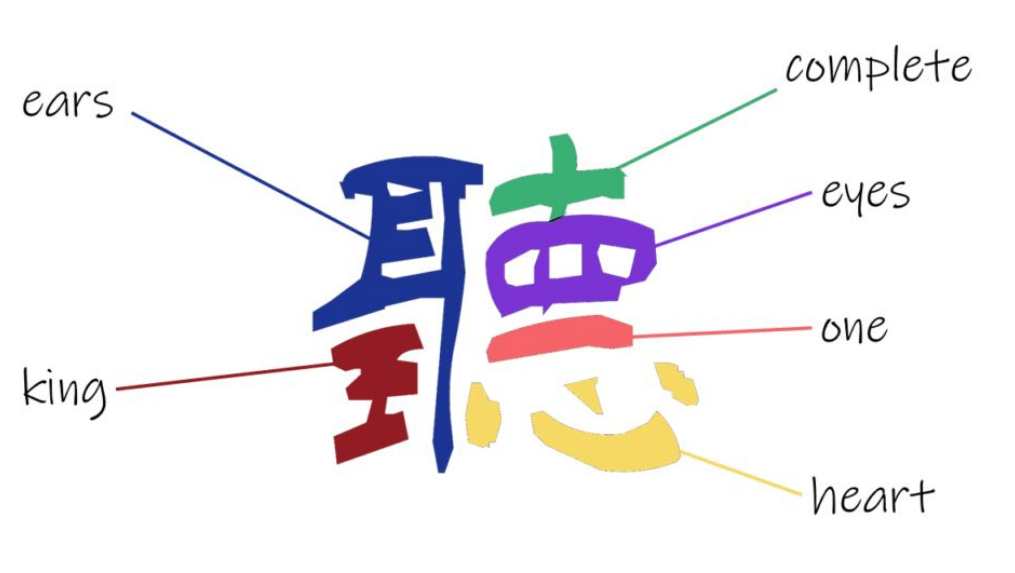
We all know how to listen, right? But have you ever considered the intricate process of listening and its ancient wisdom? In modern leadership and coaching training, we’re taught about active listening, empathy, and effective communication. What’s fascinating is that these principles aren’t modern at all—they’re ancient, embedded in Chinese characters. Take 聽 (tīng), which means ‘to listen. It’s composed of six characters:
耳 (ěr) – Ear: Listening begins with your ears, but it’s more than just hearing words; it’s about understanding the tone and topic.
王 (wáng) – King: This character implies respect. Listening means treating the speaker as a ‘King,’ valuing their words and perspective.
十 (Shi) – Complete: Complete listening involves full engagement. It means giving undivided attention, understanding, asking questions, and offering empathy—ensuring the speaker feels heard and valued.
目 (mù) – Eyes: Listening with your eyes means reading nonverbal cues like body language and facial expressions, which convey emotions and intent.
一 (yī) – One: You are the only one. No one else. No duplicates, no replicas.
心 (xīn) – Heart: listening with genuine empathy, understanding, and sincerity. It involves not just hearing the words spoken by the speaker but also connecting with their emotions, feelings, and perspective on a deeper level.
This ancient character’s evolution reflects a profound shift from passive hearing to active understanding.
It teaches us that 聽 (ting) is not merely hearing and speaking but a dynamic process of listening and comprehending.
Next time when you engage in a conversation, remember the parts of 聽 (ting)’.
Be a better listener, a trusted conversation partner, and watch how it elevates your communication and coaching skills. It’s simple yet incredibly powerful.
Share your thoughts below on how these ‘sub’ characters can enrich in today’s society in your coaching and leadership journey.
The above article can be found on the following link.